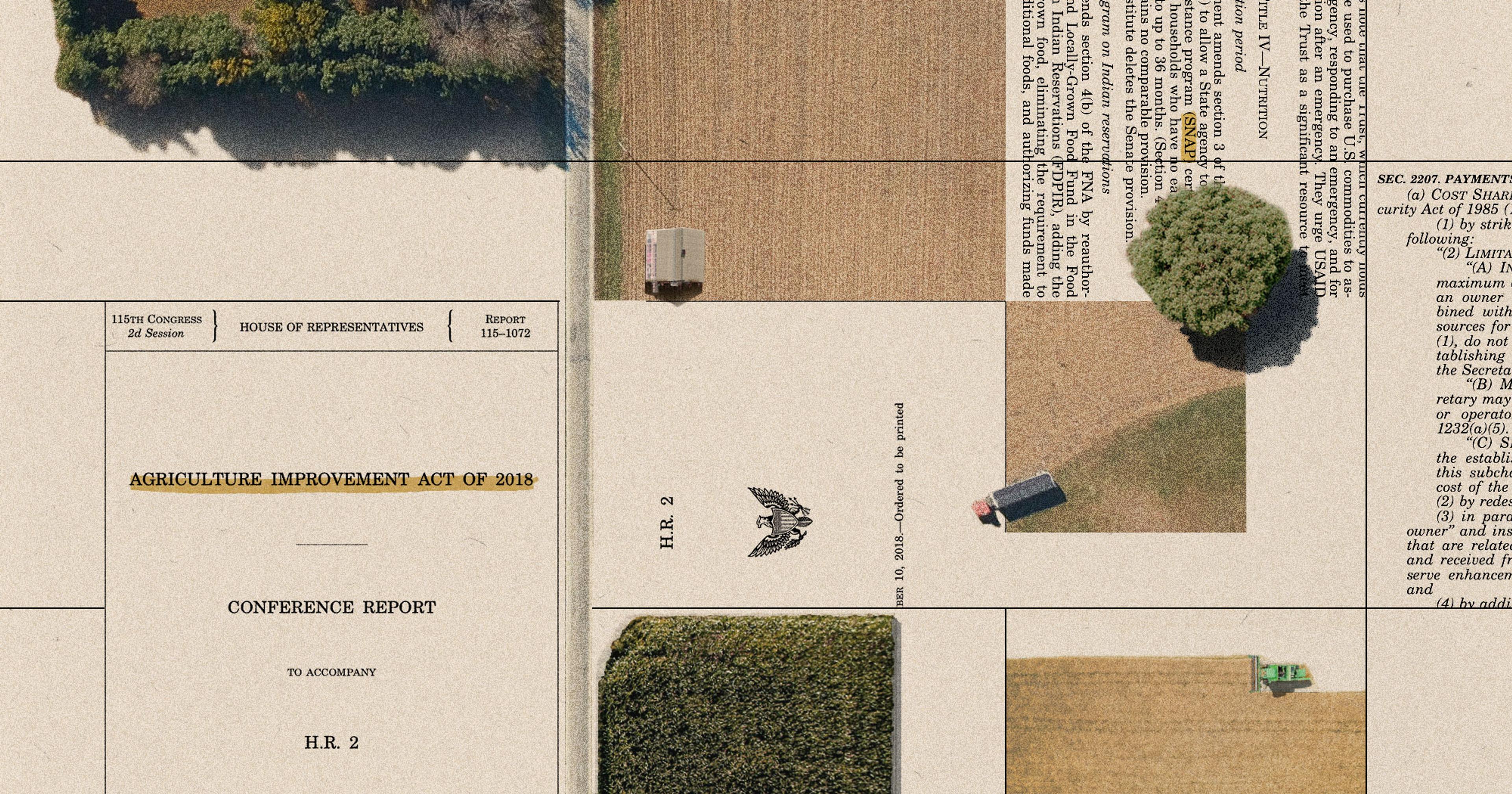
Farm Bills run in five-year increments, but it’s been almost five years since we had one in place. Will we ever have one again — and why does it matter?
Nearly a decade has passed since the last Farm Bill — the five-year, omnibus package of legislation that dictates farm and nutrition policy — was written and approved by Congress.


Now, more than two years after its September 2023 expiration date, farm policy experts say the U.S. could be entering a “post-Farm Bill” era that leaves behind critical programs like conservation and agriculture research that benefit farmers. The House agriculture committee released a proposed Farm Bill on February 13, but experts warn getting it passed through the Senate will be difficult because of bipartisan fractures in food and farming politics.
“We might be living in a post-Farm Bill world right now where we just pass farm policy through budget bills and we leave out a lot of really important research and programs that help farmers,” said Michael Happ, program associate for climate and rural communities at the Institute for Agriculture and Trade Policy.
Cracks in the Coalition
The Farm Bill has long been touted as one of the few pieces of legislation that consistently garners support from both sides of the aisle, but fissures in the farming and nutrition coalition started to appear as early as 2013. That was the year the House proposed a split Farm Bill — one bill containing Supplemental Nutrition Assistance Program (SNAP) funding, the other containing farm policy.
This would have been a major change to the Farm Bill, which has funded SNAP since 1973. Melding farm and nutrition policy into one bill was intended to get both Republicans and Democrats to work together on the Farm Bill. But in recent years, SNAP funding has become a major point of ire for Republicans. The 2013 proposal to split nutrition from farm policy passed the House and failed the Senate, but hinted at future rifts over what to include in the Farm Bill.
“I think a version of this [current stalemate] has been coming for a long time,” said Mike Lavender, policy director at the National Sustainable Agriculture Coalition (NSAC).
During the two years that have passed since the most recent Farm Bill expired, farm and nutrition policy has instead been wrapped into budget reconciliation bills that bypass the Senate’s filibuster rules. One of the most pivotal recent reconciliation bills was the OBBBA, which slashed SNAP’s budget by 20 percent while doubling funding to subsidy programs for commodities like soybeans, wheat, and corn. The bill also enforced tighter restrictions on who is eligible for SNAP and, in some states, prohibited the purchase of candy and sugary drinks with SNAP dollars. The proposed Farm Bill text maintains these cuts and restrictions to SNAP.
While nutrition and farm subsidies have become major flashpoints during the Farm Bill debates, they make up just two of the Farm Bill’s 12 titles, which include research, conservation, forestry, and rural development. The programs under those other 10 titles are what get neglected, Lavender said, hurting farmers and rural communities in the process.
“There’s all these creative things that we could be doing to really help our soils and our water quality and our air quality, but the Farm Bill as it’s written doesn’t really allow that at all.”
“This narrowing of what people fight over in a Farm Bill has been a disservice not only to getting a Farm Bill done, but to everything, all those other important, smaller policies that make an impact in people’s lives,” Lavender said.
That’s been Wendy Johnson’s experience, who farms soybeans and grain in Charles City, Iowa. Johnson grows a perennial grain called kernza, which was bred to reduce soil erosion and fertilizer runoff. The grain has been growing in popularity since it was first released by University of Minnesota researchers in 2019, but federal research funding has been limited, slowing progress to more widespread adoption of the grain.
“There’s not a lot of money that’s put into it, but my gosh, if we’re going to diversify our crops, we need that research,” Johnson said. She gets some subsidies for the soybeans she grows, but the Kernza she grows unprotected, without crop insurance or a subsidy program to make up for any market losses she might take on.
Johnson believes there is an opportunity to rethink what’s funded through the Farm Bill, potentially splitting it into different bills that better prioritize programs like grain research. “There’s all these creative things that we could be doing to really help our soils and our water quality and our air quality, but the Farm Bill as it’s written doesn’t really allow that at all,” she said.
Thompson’s proposed Farm Bill largely promises more of the same. On top of SNAP cuts, critics say it could strip state and local governments of the ability to pass agriculture policies. The proposed bill contains the controversial Save Our Bacon Act (formerly known as the EATS Act) that would allow interstate movement of livestock free from state restrictions.
Without a Farm Bill, food and agricultural policy could be left to the whims of whichever party controls the White House.
“The 2026 Farm Bill is an opportunity for Congress to reshape our food system,” said Sarah Carden, research and policy director at Farm Action, in a press release. “Instead of rebalancing the rules in favor of independent farmers and rural communities, this bill largely preserves a status quo that benefits the largest corporations.”
But if the new Farm Bill does not pass, experts warn agricultural policy could be left to the whims of whichever party controls the White House, particularly if the House and Senate majorities remain as slim as they have for the past several election cycles.
Examples of this have already occurred during the second Trump administration, like the Renewable Energy for America Program that provided grants to farmers and small business owners to install solar and make energy efficiency improvements. The program was paused last summer with no renewal in sight. The gutting of that program is in line with the Trump administration’s larger attempts to revitalize the oil industry and slow renewable energy efforts.
Planning for the future is also a lot harder for farmers without a Farm Bill. “Because we have no Farm Bill, we don’t have a five-year plan locked in,” said Ben Lilliston, director of climate and rural strategies at the Institute for Agriculture and Trade Policy.
Many of the rural development and local and regional food system programs funded by the Farm Bill are now being renewed annually, rather than every half-decade, making it difficult for farmers to know what programs they might be able to apply to in a year from now. “I don’t know how as a farmer you can really predict what’s going to happen next year,” Lilliston said.
What Now?
Experts are split over whether another Farm Bill can pass, particularly one that unites Republicans and Democrats. Jonathan Coppess, former Farm Service Agency director under President Obama and now an associate professor of farm policy at the University of Illinois, said the modern Farm Bill had reached its end during a speech at the Iowa Farmers Union in December. Coppess pointed to the OBBBA’s cuts to SNAP and the money it allocated to farmer subsidies as the final nail in the coffin for a bill that once united nutrition and farm policy.
But other experts aren’t as convinced the bill is a lost cause. “I’m not willing to say yet that the Farm Bill as we know it is dead, but I think the political ground underneath the Farm Bill has shifted and is shifting in really meaningful ways,” said Lavender of the NSAC.
“And so I think the opportunity or the imperative is, what is the right coalition of stakeholders and issues that can move a Farm Bill now?”